Selling Land With or Without Planning Permission: Which Route Gives the Better Result?
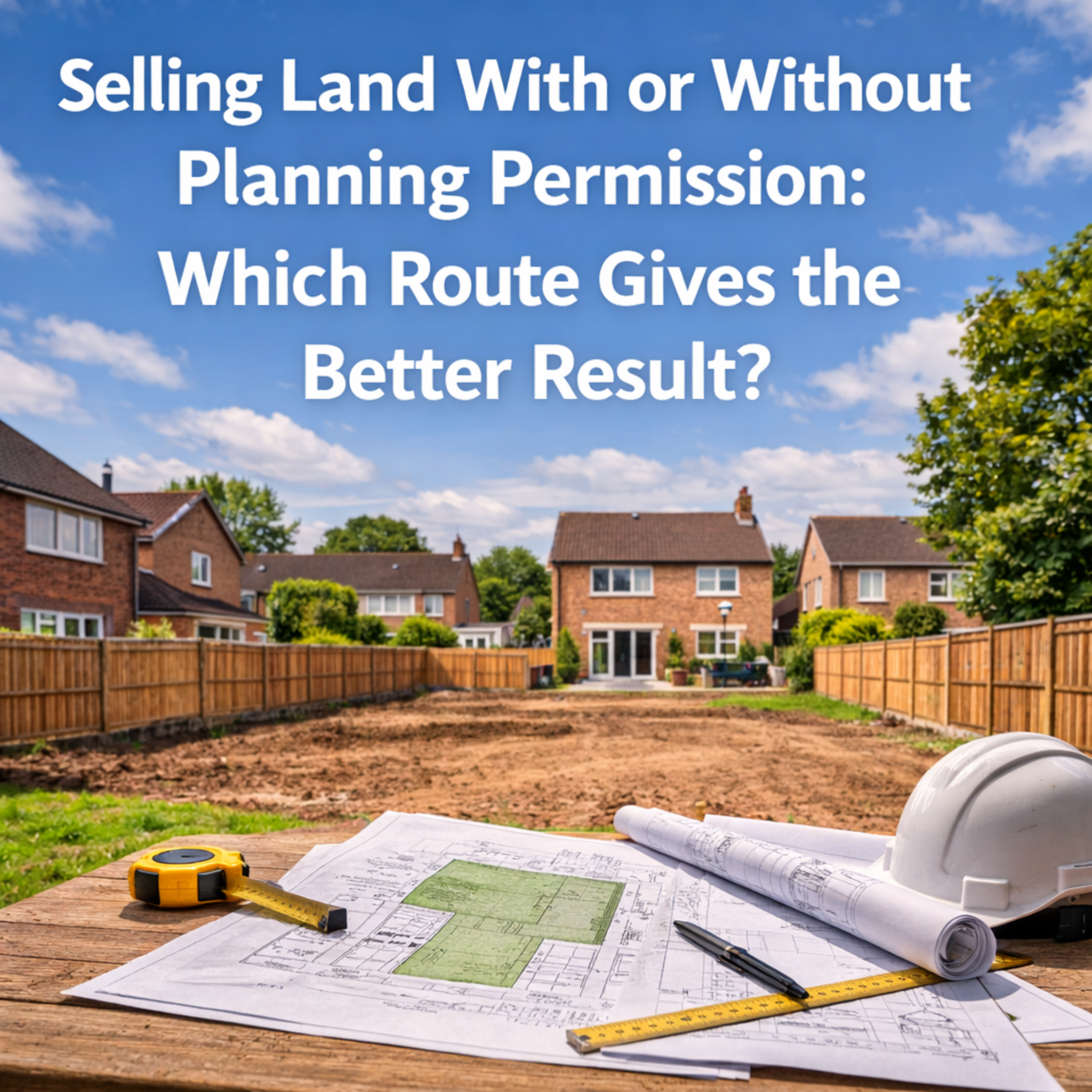
This is one of the most common questions landowners ask, and it is easy to see why. On the face of it, getting planning permission first sounds like the obvious way to raise value. Sometimes it is. But not always. In practice, the better route depends on the site, the level of confidence around planning, the owner’s timescale, and the type of buyer most likely to be interested. In other words, this is less about a fixed rule and more about choosing the right path for the plot in front of you.
There is no single right answer for every site
Owners are often told that planning equals value and no planning equals discount. That is too simple. Some sites benefit hugely from having consent in place before they are marketed. Others sell very well without it, especially when the opportunity is obvious and the right kind of buyer can see the route for themselves.
When getting planning first can make sense
If the site is unusual, policy is likely to be debated, or the opportunity needs careful explanation, planning permission can bring clarity. It gives buyers something concrete to assess. That usually broadens confidence and can make the pricing conversation easier. For more complex land, this can be a very sensible route.
When an earlier sale can make more sense
Some owners do not want the delay, cost, and uncertainty of a planning application. Others own sites where the development angle is already fairly obvious, such as a clean infill plot or a parcel that suits a smaller local builder. In those cases, taking the land to market sooner can still produce strong interest, particularly if the site is priced and packaged well.
What selling with planning permission usually gives you
Planning permission does not solve everything, but it can change the nature of the conversation in helpful ways.
Stronger certainty for buyers
Buyers like clarity. If a scheme has already been through the planning process, there is less room for guesswork. That can make a site more attractive to developers who want a more straightforward purchase rather than a speculative one.
A clearer basis for value
Once the permitted scheme is known, the discussion shifts from what might be possible to what can be built. That usually gives both sides firmer ground. It can also reduce the number of very tentative enquiries that go nowhere.
A broader pool of practical buyers
Some developers are very comfortable taking planning risk. Others would rather buy a site where that stage has already been handled. A planning consent can bring those more cautious buyers into the frame.
What selling without planning permission can still do well
Going to market without permission is not a weaker route by default. In the right circumstances, it can be exactly the right one.
It can be faster
Planning takes time, and not just in the formal decision period. There is preparation, drawings, reports, revisions, and then the wait. Some owners would simply rather sell the opportunity now and let the next owner take that stage forward.
It can reduce upfront spend and stress
Applications bring cost and commitment. That can be worthwhile, but not every owner wants to take that on. For many families, especially where the land sits alongside a main home, simplicity matters just as much as squeezing every last pound from the site.
It can work well where the site is easy to read
If the plot has strong access, sensible proportions, and clear local precedent, a buyer may be comfortable making an offer based on the planning likelihood rather than waiting for a formal consent. Smaller developers often think in exactly those terms.
The trade off many owners underestimate
There is a common assumption that getting consent first always increases the eventual result by more than enough to justify the effort. Sometimes it does. Sometimes it does not. If planning is uncertain, the process can absorb time, money, and momentum without improving the final position much at all.
Delay has a cost
Waiting months for an answer affects more than just the calendar. It can delay wider decisions, prolong uncertainty, and create a lot of mental drag for owners who simply want a sensible outcome and a clear next step.
The wrong planning push can narrow the site
Occasionally, an owner pursues a scheme that feels a little too tight or ambitious, and the market ends up reacting to that rather than to the broader opportunity. In those cases, a thoughtful open market approach can sometimes land better than a fixed consent that feels compromised.
There are middle routes as well
Not every decision is a straight choice between full planning first and a clean immediate sale.
Option agreements
These can allow a developer to secure the right to buy the land, subject to planning or other agreed steps. For some owners, that offers a useful balance between value and risk. For others, the delay is less attractive.
Conditional deals
A conditional sale can make sense where both parties see the opportunity but want the purchase to complete only once certain milestones are met. The right structure depends heavily on the site and the owner’s priorities.
What tends to work best locally?
In and around Hemel Hempstead, smaller sites often perform best when the route is chosen honestly rather than automatically. If the planning case is strong and the scheme needs that extra layer of certainty, then pursuing consent can be the right move. If the site is already easy to understand, an early sale to the right buyer can be just as effective and a great deal simpler.
The key is not to start with a fixed belief about the best route. Start with the site, the likely buyer, and the owner’s appetite for time and risk. Once those three things are clear, the right strategy usually becomes much easier to see.
If you are also weighing up site acquisition, planning support, or development strategy more broadly, our Developer Services page gives a useful overview of how we support owners and developers across the process.
Not sure whether planning first is worth it?
If you would like an honest view on whether your site is better sold now or worth pushing further before launch, our Land and New Homes team will help you weigh it up properly.