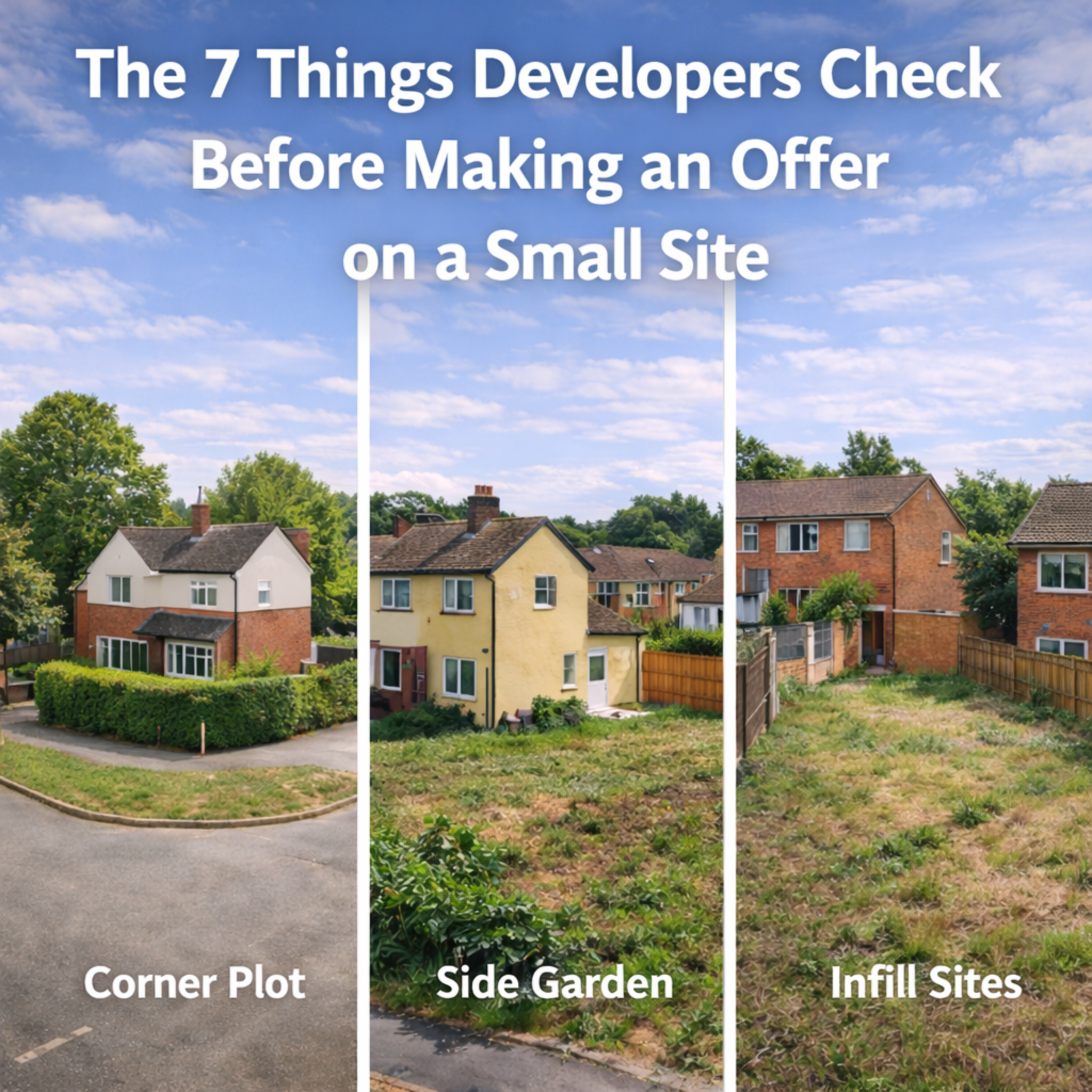
The 7 Things Developers Check Before Making an Offer on a Small Site
Owners are often surprised by how quickly an experienced developer sizes up a site. What looks like a simple plot from the outside can raise a long list of questions underneath. Access, layout, planning context, build cost, buyer demand, and risk all come into play very early. If you understand what a developer is likely to look at before they put forward a figure, you are far less likely to misread the offer or the opportunity.
Why this matters to landowners
The point is not to start thinking like a developer for the sake of it. It is to understand how your site will be judged in the real market. That helps with pricing, presentation, timing, and even the decision about whether to market now or do more work first. It also helps owners separate a serious offer from a casual one.
1. Can they get in, build it, and sell it without a headache?
Access is often the first real test. Can construction traffic reach the site? Is there practical frontage? Will neighbours, rights of way, or awkward shared areas make delivery more difficult? A site that looks attractive on paper can quickly lose appeal if the route from road to build is full of friction.
2. What does the planning context really suggest?
Developers do not just ask whether planning might be possible. They look at how likely, how clean, and how defendable the proposal seems. That means checking nearby approvals, street form, density, overlooking, parking, and the wider tone of the local setting. A smaller site in Hemel Hempstead can still work very well, but only if the eventual scheme feels like it belongs there.
3. Do the numbers stack up once the real costs are included?
This is where a lot of optimism gets tested. A developer will work back from likely sale price and then strip out build cost, finance, professional fees, planning, utilities, contingencies, and profit. If the margin becomes too thin, the offer will soften, no matter how attractive the plot first appeared.
4. What are the awkward issues that could slow things down?
Tree constraints, neighbouring windows, retaining walls, drainage routes, easements, service runs, and unusual boundaries all matter. A developer is not looking for perfection, but they do need to understand where the complications lie. The more uncertainty a site carries, the more cautious the pricing tends to be.
5. Does the layout allow a home people will actually want?
Developers are not simply buying permission or footprint. They are buying the chance to create a finished product that will appeal in the open market. That means room proportions, parking, natural light, outside space, privacy, and overall liveability matter a great deal. A technically possible scheme is not always a commercially appealing one.
6. Who is the end buyer likely to be?
A smart small site offer is shaped by buyer demand. Will the finished home suit a first time buyer, downsizer, commuter couple, or family? Is the location strong for that audience? Does the surrounding road support the right price point? In the better schemes, the finished home makes sense long before it is built.
7. How much certainty do they really have?
This is the question behind almost every offer. Developers know that even good sites come with moving parts. The more certainty they can see around planning, buildability, and eventual resale, the stronger they tend to be. Where too many assumptions are needed, the price usually reflects that hesitation.
What should owners gather before the site goes to market?
You do not need a huge file of reports just to start a conversation, but better information nearly always helps.
Clear title information
Ownership, boundaries, and access arrangements are basic, but they matter. Early clarity avoids wasted time later on.
A realistic view of what the site may suit
The right guide price and the right buyer audience often depend on understanding the likely scale and type of opportunity, not just the size of the land.
Useful local planning context
If there are nearby examples that help explain the opportunity, they can shape confidence and improve the quality of conversations from day one.
A marketing strategy that speaks to serious buyers
Small site sales work best when the presentation is clean, the information is proportionate, and the buyer audience is properly understood. Too vague and you attract time wasters. Too narrow and you miss the right people.
Good land advice is often about reducing noise
Owners do not need a dramatic pitch. They need an honest view on how the site is likely to be assessed and what can be done to improve the way it goes to market. Once you understand what developers actually check, their offers become easier to read and your own options become a lot clearer. That usually leads to a better decision, whether you sell now, prepare further, or decide the site is not right to move on just yet.
If you would like to see how we support landowners and developers at different stages of the process, take a look at our Developer Services page.
Thinking of selling a small site?
If you would like a practical view on how a developer is likely to assess your plot, and how it should be positioned to the market, our Land and New Homes team will help you make sense of it.