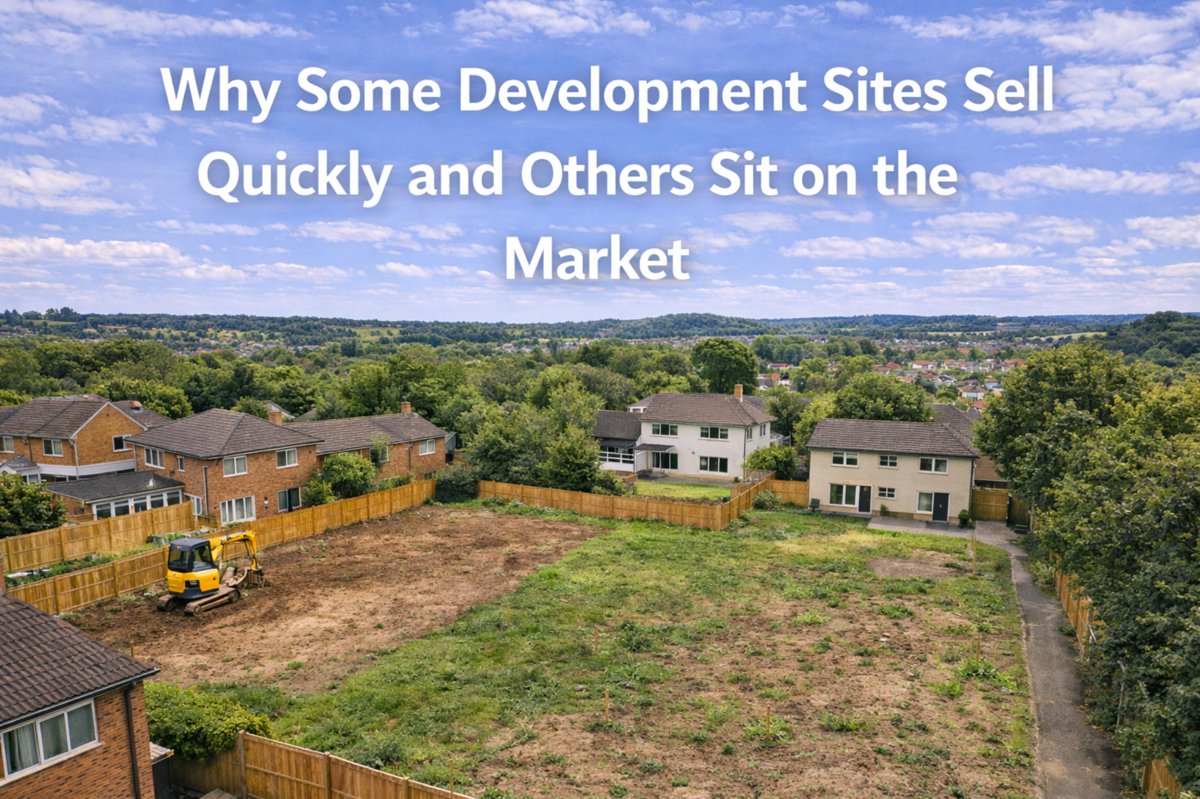
Why Some Development Sites Sell Quickly and Others Sit on the Market
When a good development site hits the market, people often assume it will sell itself. Sometimes that happens. More often, it does not. Small and medium sized land opportunities can be very sensitive to pricing, presentation, timing, and buyer targeting. Two sites that look similar at first glance can perform very differently once they go live. Usually, the reason is not luck. It is how clearly the opportunity is understood and how confidently it is brought to market.
It usually starts with the guide price
Pricing is where momentum is often won or lost. If the guide is set too high, serious buyers step back and the site quickly feels stale. If it is set too low without a clear strategy behind it, owners worry they are giving the land away. The best guide price is rarely the most flattering number. It is the number that invites the right level of confidence from the right buyers.
Developers are buying a margin, not just a location
Even attractive land in a strong part of Hemel Hempstead still has to work on paper. If the guide does not leave enough room for build cost, planning, finance, and profit, the buyer pool becomes very thin. When that happens, a site can sit for months even though the location itself is perfectly good.
A realistic launch often creates better leverage
In many cases, realistic pricing does more for the final outcome than a confident over ask launch. Good sites tend to gather strength when multiple serious parties can justify engaging early.
Packaging matters more than many owners expect
Land buyers do not only react to the site. They react to how easy it is to understand. If the information is vague, inconsistent, or thin, hesitation follows very quickly.
Strong presentation removes friction
Clear boundaries, practical context, a believable route to value, and a sensible summary of the opportunity all help. Buyers do not need pages of sales language. They need enough structure to see why the site deserves proper attention.
Overstated opportunities can slow a sale
If the marketing pushes too hard or implies more certainty than the site really has, good buyers often become cautious. The better route is usually straightforward, well judged, and honest about what is known and what still needs work.
The wrong buyer audience wastes time
Not every development site suits every buyer. A clean small infill plot may appeal to a local builder or self builder. A more planning led opportunity may be better suited to a land buyer or developer with a longer horizon. The faster sales tend to happen when the audience is understood before launch, not guessed after it.
Serious buyers respond to relevance
When the marketing reaches people who genuinely understand the opportunity, enquiries are better, viewings are more purposeful, and negotiations move with more confidence. Generic exposure on its own is not enough.
Unanswered questions slow everything down
Most stalled land sales have a cluster of small doubts sitting underneath them. It might be access, title, planning history, site constraints, neighbouring impact, or simply uncertainty about what the land is likely to suit. Buyers do not always walk away immediately, but they do slow down. And once momentum goes, offers often become more cautious.
Good preparation does not mean overworking the site
Owners do not need to answer every technical question before marketing. But the main issues should be understood well enough that serious conversations can move forward cleanly. The aim is clarity, not complexity.
Local judgement makes a real difference on smaller sites
With standard residential homes, broad market knowledge can sometimes take you a fair way. Smaller land opportunities are less forgiving. Buyers want to understand local street character, likely end demand, what sort of design sits comfortably in the area, and how similar sites have been received nearby. That is where local judgement becomes commercially useful.
Small sites are often won by nuance
On a tight urban plot or a side garden opportunity, the detail matters. Parking, scale, overlooking, shape, and final buyer appeal can make the difference between a site that feels attractive and one that feels just a bit too difficult. Those are usually local calls, not generic ones.
Momentum is often created before the launch day
The better land sales are rarely just uploaded and left to get on with it. They are thought through first. The route is chosen, the likely buyer is understood, the information is gathered, and the guide price is set with purpose. That preparation tends to show up very quickly once the site reaches the market.
Where sites drift, it is usually because one of the basics is off. The guide is too ambitious, the opportunity is not being explained properly, the buyer audience is too broad, or there are unresolved questions slowing confidence. None of those issues are fatal, but they are usually the reason one site moves and another sits.
If you would like to see the type of development opportunities our team has already sold, our Past Developments page is a useful place to start.
Thinking about bringing a site to market?
If you would like a practical view on how your site should be priced, packaged, and positioned to serious buyers, our Land and New Homes team will be happy to talk it through.
Related guide
Past Developments Sold by David Doyle
See examples of land and new homes opportunities already sold by our team, from individual plots to wider development schemes across Hertfordshire.