How Developers Work Out What They Can Pay for Land
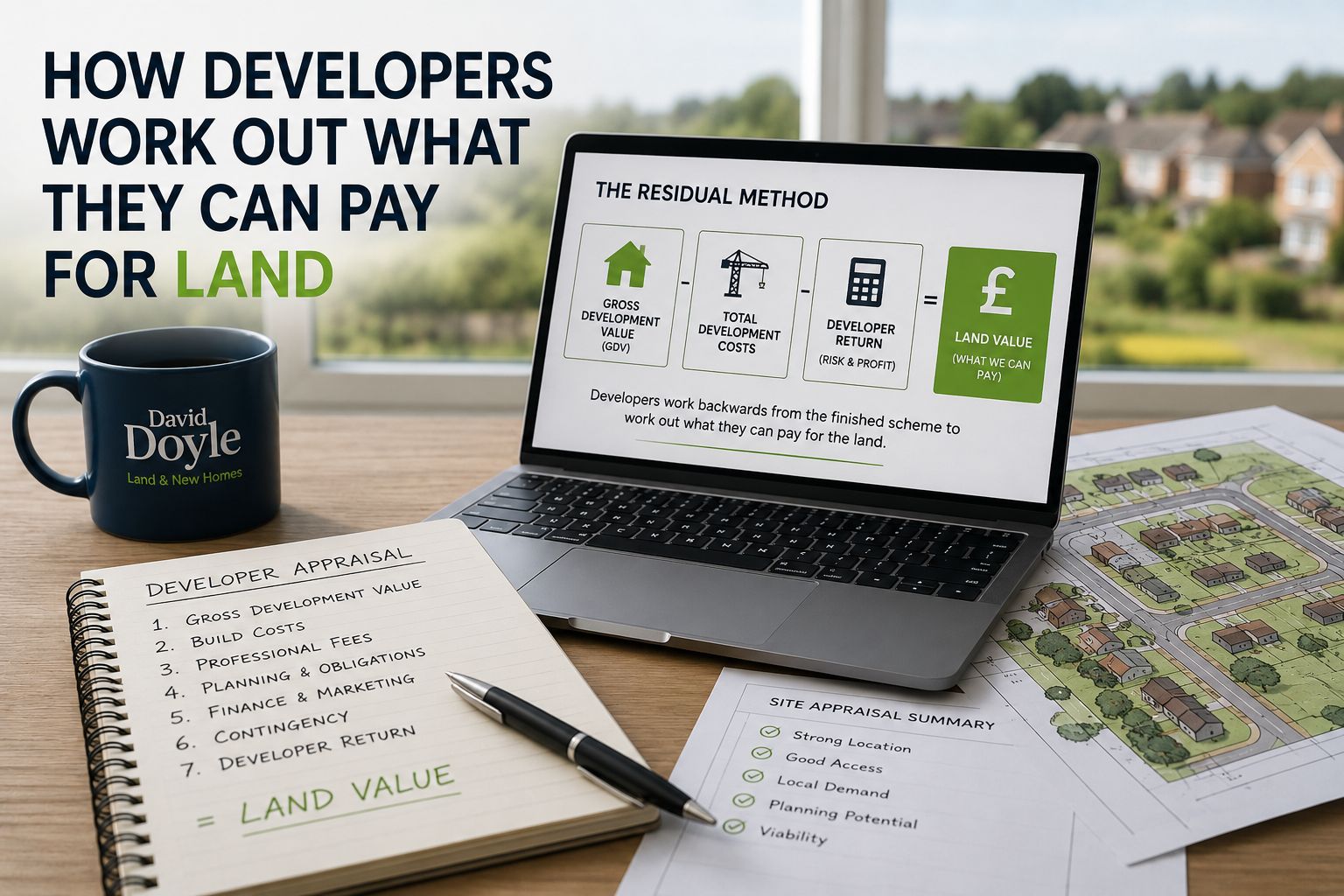
When a landowner first considers selling land, one of the biggest questions is usually simple: how much is it worth? The answer is rarely as straightforward as measuring the plot or looking at nearby house prices. Developers work backwards from what can realistically be built, sold, funded, and delivered.
Land Value Starts With the Finished Homes
Developers usually begin by estimating the likely value of the completed homes. This is often called the gross development value.
For example, if a site could support two new homes, the developer will consider what those homes might realistically sell for once built. That figure is important, but it is only the starting point.
The land value is not the same as the finished value of the new homes.
Build Costs Come Next
Once the likely end value is considered, developers then look at the cost of building the scheme.
This includes more than bricks, materials, and labour. It can also include demolition, site clearance, access works, drainage, utilities, landscaping, professional fees, surveys, warranties, finance, insurance, and contingency.
Some sites that look simple at first can become more expensive once the practical details are understood.
Planning Risk Affects What a Developer Can Pay
A site with planning permission usually gives a developer more certainty than a site without permission.
That does not mean land without planning has no value. Many developers are comfortable taking planning risk, particularly where there is strong local precedent. However, they will usually factor that risk into what they are prepared to pay.
The less certain the planning position, the more cautious the offer is likely to be.
Developer Margin Is Not Just Profit
Landowners sometimes see developer margin as simple profit, but it is really a reflection of risk.
A developer takes responsibility for funding, planning risk, construction risk, market changes, delays, professional costs, and sale risk. Their return needs to reflect the level of uncertainty involved.
If costs rise or sale values soften, the developer’s margin can reduce quickly. This is one reason offers may seem more conservative than expected.
Why Offers Can Vary So Much
Different developers may reach different views on the same site.
One may have lower build costs, stronger funding, or a better understanding of the local resale market. Another may be more cautious because the site does not suit their usual model.
This is why matching land to the right type of buyer matters. The best buyer is not always the one making the quickest approach.
What Landowners Often Overlook
Many landowners focus on the maximum number of homes that could fit on a plot. Developers tend to focus on what can realistically be approved and sold.
A smaller, well designed scheme may sometimes create stronger value than a larger proposal that pushes the site too hard and increases planning risk.
Why Local Market Knowledge Matters
In Hemel Hempstead, values can vary significantly depending on location, property type, parking, outlook, school access, station access, and local buyer demand.
A developer considering a site in Boxmoor, Apsley, Leverstock Green, Gadebridge, or one of the surrounding villages may take a different view depending on the likely end buyer.
This is where local estate agency insight adds value. Development appraisal is not only about planning. It is also about understanding what the finished homes will be worth in the real market.
The Bottom Line
Developers calculate land value by working backwards from the finished scheme. They consider end values, build costs, planning risk, finance, timing, and the return needed to justify taking the project on.
For landowners, this means the best first step is not guessing a figure or relying on an online estimate. It is understanding how developers are likely to view the site and what route could create the strongest result.
At David Doyle, our Land and New Homes team helps landowners understand land value in practical, local terms before making decisions about planning, marketing, or developer approaches.
Wondering What Your Land Could Be Worth?
Speak to our Land and New Homes team for clear, local advice on land value, developer demand, and the best route forward.
You might also be interested in
Aug 22, 2026
What Happens After You Agree to Sell Land to a Developer?
Agreeing to sell land to a developer is a significant step, but it is rarely the end of the process. Once terms are agreed, there are still important stages to work through, including due diligence, l