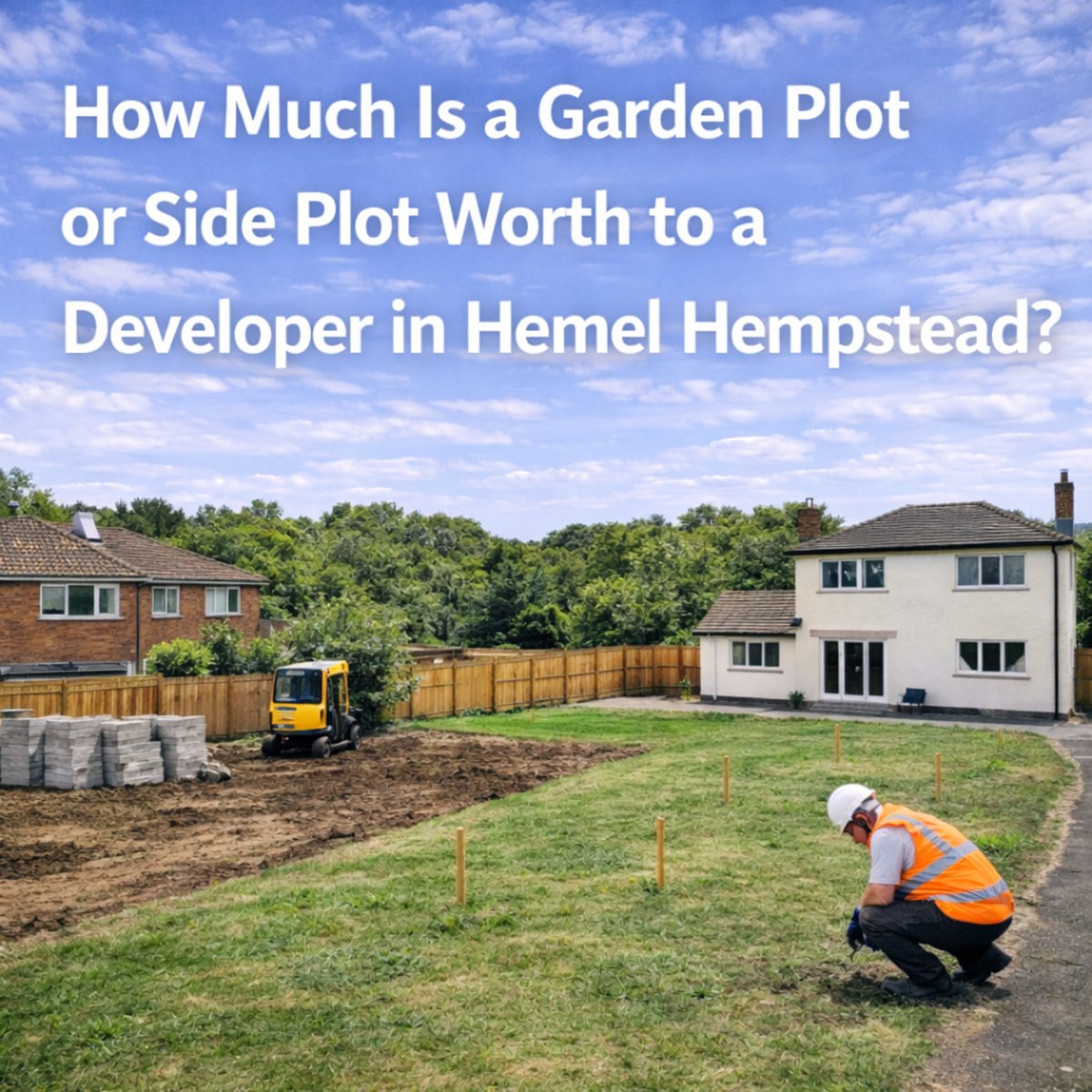
How Much Is a Garden Plot or Side Plot Worth to a Developer in Hemel Hempstead?
A lot of land conversations start the same way. Someone has a wide side plot, a corner position, or a garden that feels bigger than it needs to be, and they wonder whether there is real development value there or whether it is just one of those ideas that sounds good over a cup of tea. In Hemel Hempstead, some plots do carry genuine appeal to developers, but value is rarely about spare land on its own. It usually comes down to whether the site can support a sensible scheme, with enough certainty to make the numbers work.
What actually creates value in a small plot?
The simple answer is this. A developer is not buying grass, fence lines, or the idea of potential. They are buying the chance to create a finished home and still leave room for cost, risk, and profit. That means the site has to do more than feel large.
Access and street presence
If a plot has its own clear access from the road, interest tends to be stronger. A side plot on a wider road, a corner plot with natural frontage, or land that already sits comfortably within the street scene is usually easier for a developer to assess. Rear land without obvious access can still work, but the pool of buyers is often smaller and the risk is higher.
Shape, width, and usable layout
Some plots look generous until you start trying to place a house, parking, turning space, private outside area, and sensible boundaries on them. Long narrow pieces of land can be awkward. Equally, a plot that looks modest on paper can still work well if the shape is clean and the layout is easy to understand. Developers tend to pay more attention to usable form than headline size.
Planning context and local precedent
Nearby planning history matters. If similar infill homes, side plots, or garden developments have already been approved nearby, that usually gives a buyer more confidence. It does not mean consent is guaranteed, but it helps create a more believable route. In parts of Hemel Hempstead, where plot patterns and street form already support this kind of development, interest can be stronger from the start.
Impact on the existing home
One of the biggest misconceptions is that extra land value simply adds itself on top of the value of the current house. It is not always that tidy. If selling off part of the garden leaves the existing house compromised, with less privacy, weak parking, or an awkward layout, the value equation changes. Good small site advice looks at both sides of the picture, not just the new plot.
Demand for the finished product
Developers usually work backwards. They ask what the finished home would sell for, who would buy it, and how confidently it would move in the local market. A neatly designed two or three bedroom home in the right Hemel Hempstead setting can attract strong interest. A scheme that looks forced, overdeveloped, or out of place tends to soften appetite very quickly.
Why headline plot values can be misleading
This is where owners often get mixed messages. One person talks about what the finished house might be worth. Another throws out a number based on a plot they heard about elsewhere. Then a developer offers something lower and it feels disappointing. Usually, the gap comes from how land is actually appraised.
Gross development value is not land value
Even if a finished new home could sell well, that does not mean the land is worth a huge percentage of that number. Build costs, finance, planning, professional fees, drainage, services, contingencies, and profit all sit in between. Small plots can be valuable, but the route from idea to completed home is never free.
Abnormal costs can change the picture quickly
A plot may look attractive until questions arise around access works, retaining walls, tree constraints, service diversions, or difficult ground conditions. These are the details that can turn an optimistic figure into a more cautious one. That is why sensible site advice is worth more than a quick guess.
Small sites are often priced on certainty
If a buyer can see a clear route, they tend to act more confidently. If the site is full of question marks, offers tend to reflect that. In other words, value is not just about potential. It is also about how believable that potential looks to the person spending the money.
The kinds of plots that can attract real interest
There is no perfect formula, but certain opportunities come up again and again in local conversations.
Side plots on wider roads
Where a house sits well back or to one side, with room for independent access, developers often take notice. This can be especially true where the surrounding road already has a varied street pattern rather than tight uniform spacing.
Deep rear gardens with separate access potential
Not every large garden is suitable, but some offer enough depth and practical access to justify a closer look. The key is whether the resulting layout would still feel sensible for both the existing house and any new home.
Corner plots
Corner positions often give a site clearer identity and easier visibility. That matters for planning, design, and eventual resale. It is one reason why corners can outperform ordinary spare garden space.
Redundant garages or oversized parking areas
Sometimes the opportunity is not a classic garden plot at all. It might be underused garage land, a tired side area, or a section of ground that no longer adds much day to day value to the existing property but may hold appeal for a smaller scheme.
What should you do before putting a figure on it?
The best starting point is usually not to leap straight to a price. It is to understand what the site is likely to be to a buyer.
Check title, access, and boundaries
Even an apparently simple plot can become more complicated once ownership lines, rights of way, or access arrangements are looked at properly. Early clarity makes later conversations easier.
Look at nearby planning history
You are not looking for a perfect match. You are looking for signs of how similar sites have been viewed locally. That often gives a more useful starting point than broad national advice.
Think about the likely buyer
Would the site appeal to a self builder, a smaller local developer, or a more experienced land buyer? Each will assess value differently. Marketing works better when the likely audience is clear from the outset.
Get a proper land appraisal
A good appraisal should look at planning context, likely end values, local demand, and the practical compromises involved. It should also give you an honest view of whether now is the right time to sell or whether more preparation is worth doing first.
The best outcome is not always the biggest first number
Most owners are not just chasing a headline price. They also want clarity, low hassle, and confidence that they are not leaving money on the table or walking into the wrong deal. That is why the best conversations tend to start with what the plot really is, who it is likely to suit, and what route gives the strongest balance between value and certainty. If the site has genuine potential, that usually becomes clear quite quickly once it is looked at properly.
If you would like to see the kind of land and development opportunities our team has already sold across the area, you can also browse our Past Developments page for context.
Wondering whether your plot has real development value?
If you would like a straight view on whether a side plot, corner plot, or part of your garden is likely to interest a developer, our Land and New Homes team will talk it through with you.
Related guide
Past Developments Sold by David Doyle
Take a look at the land and development opportunities already sold by our team across Hemel Hempstead, Boxmoor, Berkhamsted, and the wider Hertfordshire area.