Planning Permission Refused? Why Your Land May Still Have Options
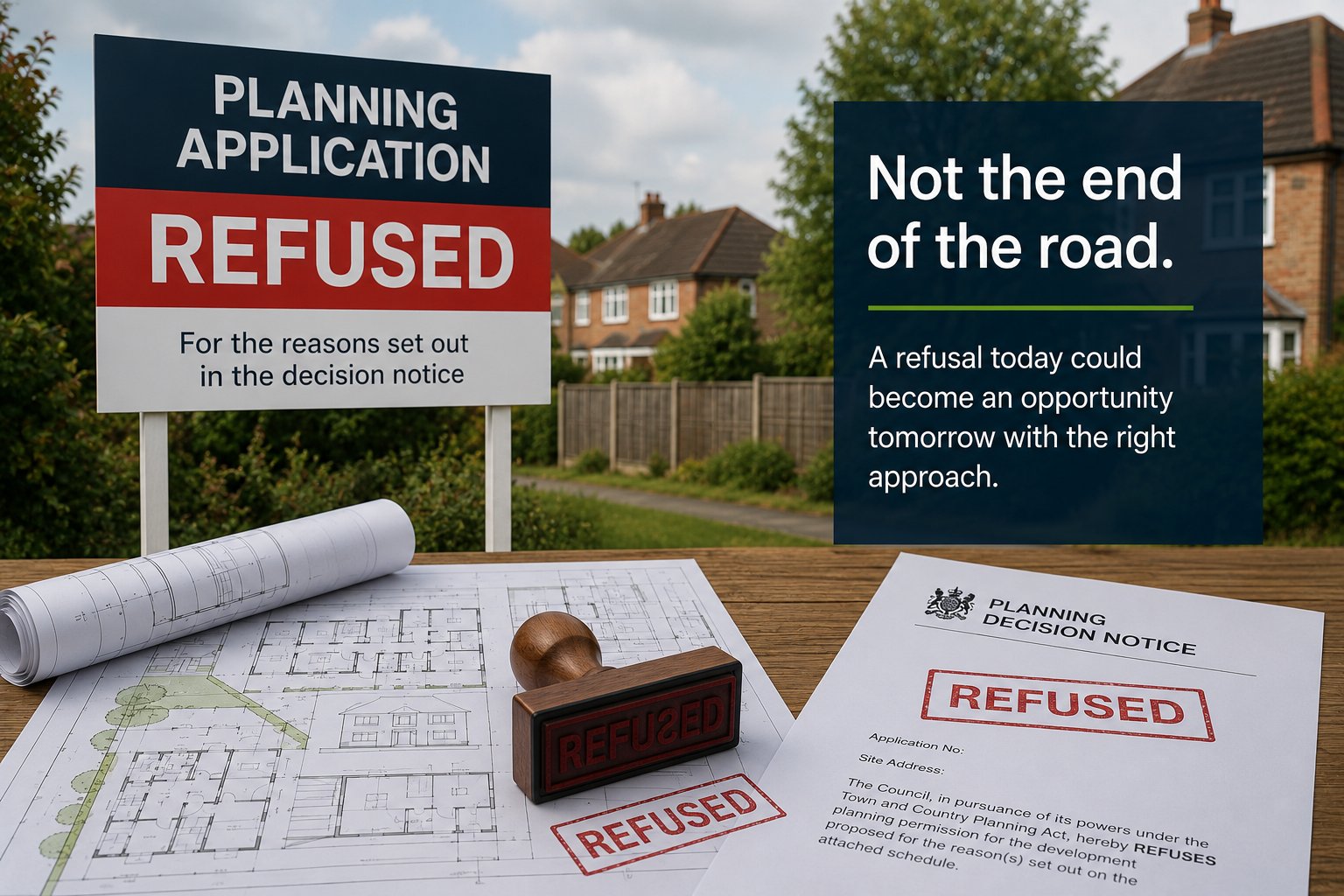
A refused planning application can feel like the end of the road, especially if you have already invested time, money, and energy into exploring development potential. But a refusal does not always mean the opportunity is over. In many cases, it simply means the proposal, timing, or strategy needs to be reviewed properly.
Why Planning Permission Gets Refused
Planning applications can be refused for many reasons. Some are fundamental, but others are capable of being addressed with better design, stronger evidence, or a more realistic approach.
Common reasons include concerns around access, parking, scale, overlooking, impact on neighbouring homes, design quality, drainage, trees, biodiversity, or the relationship with the surrounding street.
The important thing is not just that permission was refused. It is why it was refused.
Start With the Decision Notice
The refusal notice is the first document to review carefully. It should set out the council’s reasons for refusing the application.
Some reasons may be technical. Others may relate to judgement, such as whether the proposal feels too dominant or out of keeping with the area.
A good review looks at each refusal reason separately and asks whether it can realistically be overcome.
One Refusal Does Not Always Close the Door
Landowners sometimes assume that once a site has been refused, no developer will be interested. That is not always the case.
Developers often look beyond the headline refusal. They want to understand whether the site itself has potential, whether the previous scheme was too ambitious, and whether a better proposal could succeed.
A refused application can still provide useful information. It tells you what the council did not support, which can help shape a stronger route next time.
Could a Revised Scheme Work Better?
Sometimes the issue is not the principle of development, but the way it was proposed.
A revised scheme might involve fewer homes, a different layout, improved access, better parking, more sensitive design, or stronger landscaping.
In some cases, a smaller and better considered scheme may be more valuable than continuing to push a proposal that planning officers are unlikely to support.
Should You Appeal or Reapply?
After a refusal, there may be more than one route forward.
An appeal may be appropriate where there is a strong planning case and the refusal reasons can be challenged. A revised application may be better where the council’s concerns are valid but can be addressed.
This decision should not be rushed. Appeals take time and carry risk. A new application may be more practical if the proposal can be improved.
Why Market Advice Still Matters
Planning potential and market value are closely connected.
Before spending more money, it is worth understanding whether developers would still be interested in the site and what type of proposal they would consider commercially realistic.
There is little benefit in pursuing a planning route that does not align with buyer demand or development viability.
When a Refusal Can Actually Help
A refusal can be frustrating, but it can also bring clarity.
It may show that the original proposal was too large, that access needs rethinking, or that the site needs a different buyer or strategy.
Handled properly, that information can help avoid further wasted cost and move the landowner toward a more achievable outcome.
The Bottom Line
A refused planning application is not always the end of the opportunity. It is a point to pause, review, and decide whether the site still has a realistic route forward.
For Hemel Hempstead landowners, the key is to understand the refusal properly, assess whether the issues can be addressed, and consider the market position before making the next move.
At David Doyle, our Land and New Homes team can help landowners take a practical look at sites with planning history, including refused applications, and consider what options may still be available.
Had Planning Permission Refused?
Speak to our Land and New Homes team for clear, local advice on whether your land may still have options.
You might also be interested in

Aug 22, 2026
What Happens After You Agree to Sell Land to a Developer?
Agreeing to sell land to a developer is a significant step, but it is rarely the end of the process. Once terms are agreed, there are still important stages to work through, including due diligence, l